MCDM-Based Design Decision-Making for Feeding Assistive Technology in Neurodegenerative Diseases: A Case Study of Parkinson's Disease
A Case Study of Parkinson's Disease
Keywords:
Parkinson’s Disease; Feeding Assistive Technology; Multi-Criteria Decision Making (MCDM); Kano Model; Analytic Hierarchy Process (AHP); Design for Dignity; Sociotechnical Systems.Abstract
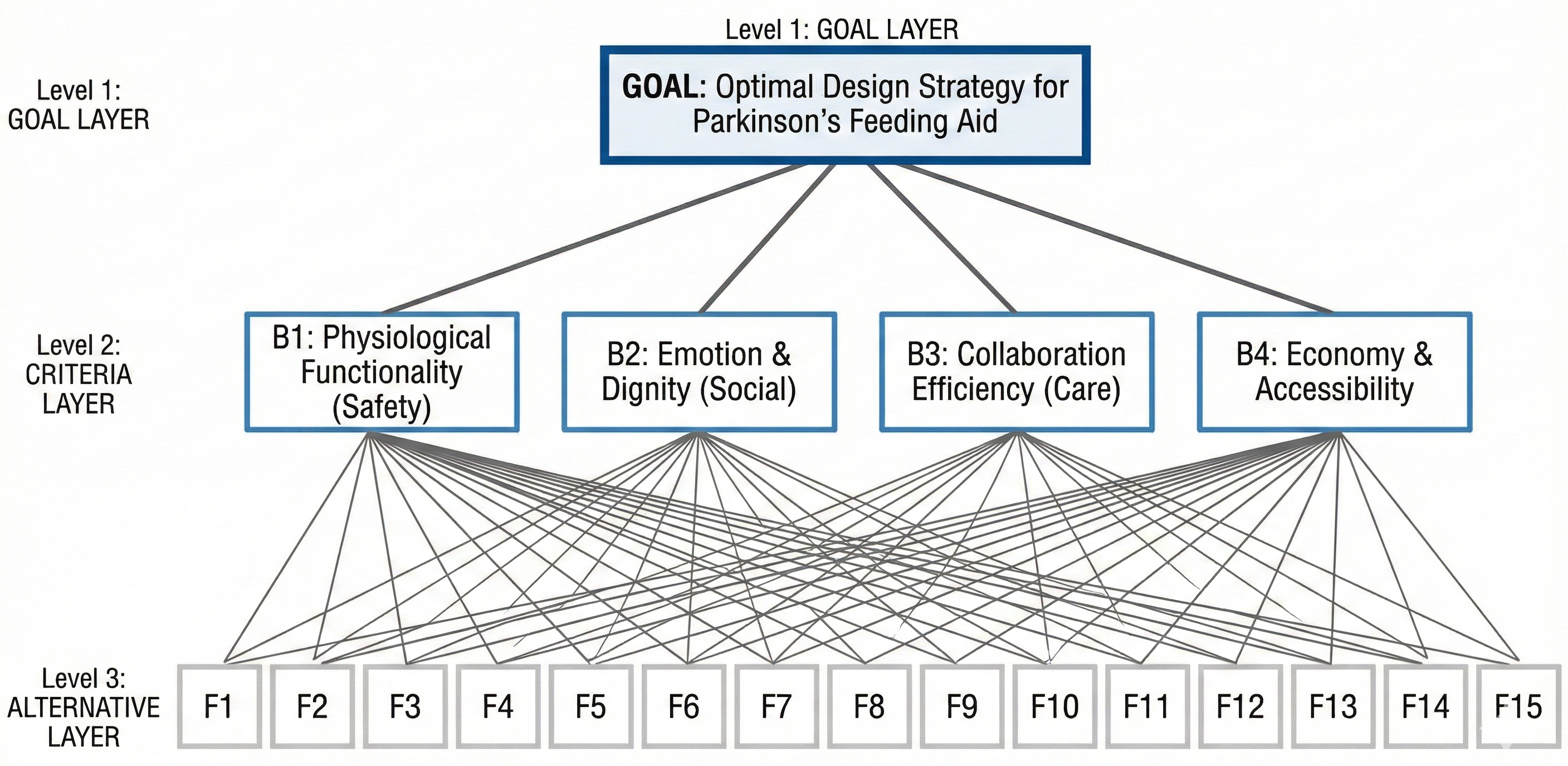
Abstract—Although a considerable engineering investment in Parkinson's disease (PD) auxiliary technology, this current solution still faces an endless paradox: "high-tech funds raised high), it is difficult to be universal". The main reason for this failure is the sheer imbalance and focus placed on preventing essential physiological tremor while completely ignoring psychosocial requirements. To solve the mystery of "black box" in design decision-making, a new hybrid multi-standard decision-making (MCDM) framework has been proposed by combining system review (PRISMA), Carnot model and analytical hierarchy process (AHP). Fifteen design factors are synthesized through the interdisciplinary literature review guided by PRISMA. Kano questionnaire and rankinga of the demand attribute from 24 PD patients was evaluated by AHPb from 24 experts to establish a global weight. Three important insights are uncovered by the study: (1) Reaffirming the Physiological Foundation: Active stabilization (F1, w=0.149) retains its status as the most significant attribute, confirming that functional tremor suppression remains the non-negotiable priority; (2) Dignity as a Baseline: Invisible/de-medicalized aesthetics (F13, w=0.064) was classified as a 'Must-be' attribute rather than a value-add, validating that destigmatization is a prerequisite for adoption; (3) Emergence of Intelligence: Tremor data monitoring (F11, w=0.095), previously considered a "value liability", unexpectedly ranked third, marking a shift towards data-driven disease management. Therefore, the article suggests "Safety & Dignity (Foundation) – Intelligence (Engine)" as a hierarchical design strategy set. From these findings, it is proposed that the next generation of assistive technologies should shift from a "prosthetics for limb" paradigm to "guardians of self", wherein technology and humanity are jointly optimized through quantified humanistic care.