Design Strategies for Unleashing Intelligent Care Environments: A Triangulated Methodological Study Using PLS-SEM, ANN, and fsQCA
Keywords:
Intelligent care environment; SEIPS model; methodological triangulation (PLS-SEM/ANN/fsQCA); digital friction; nurse occupational well-being; evidence-based design.Abstract
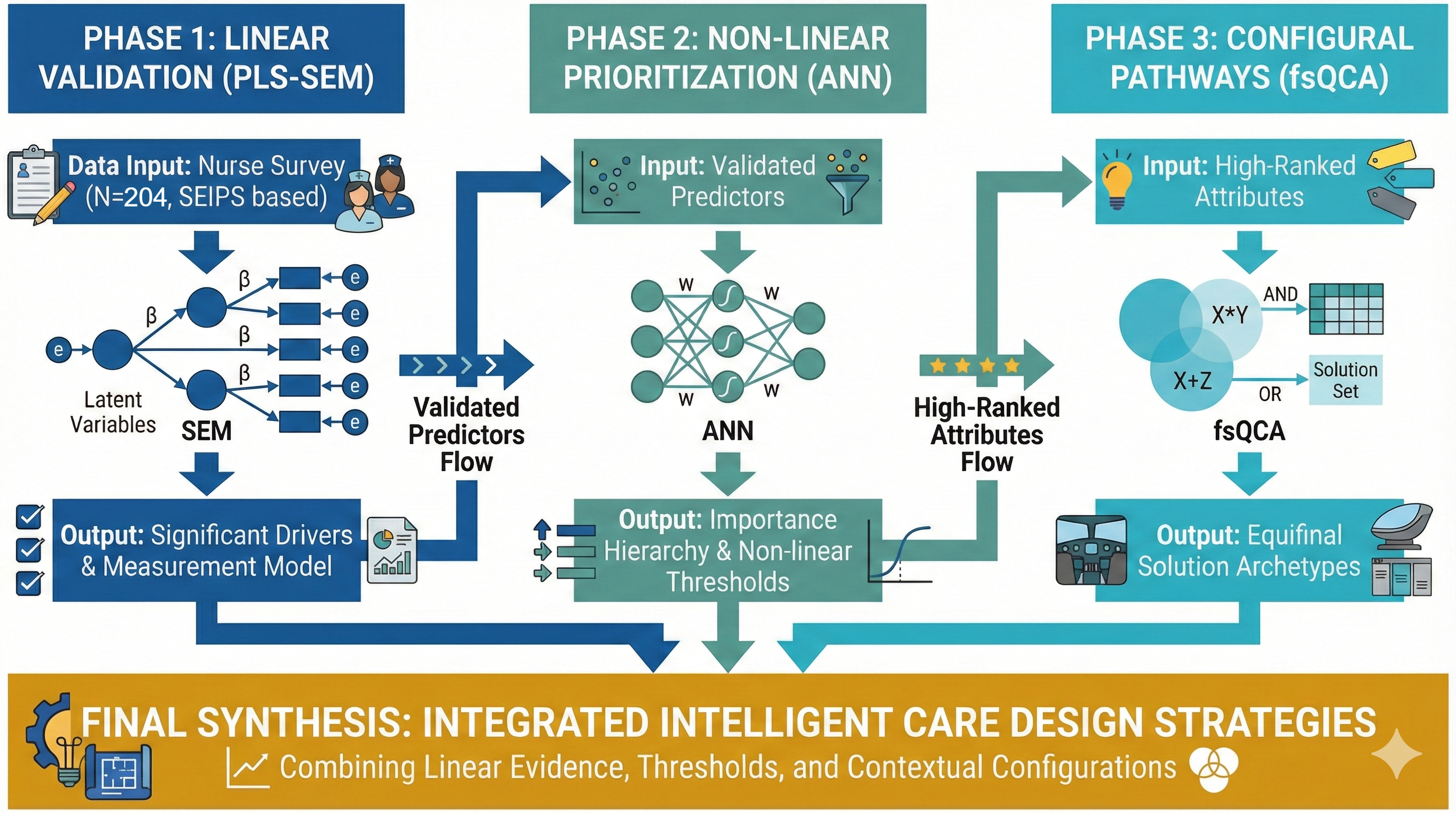
Abstract—Despite the rapid digital transformation in the medical field, nurses in general wards often face the issue of "digital friction." This arises because advanced work technologies and outdated physical environments are mismatched, leading to cognitive burdens. Most existing studies use linear analysis methods, making it difficult to capture the complex, non-linear relationships between physical environments and technological stressors. Objective: Based on the SEIPS 3.0 model, this study aims to decode the complex causes affecting nurses’ occupational well-being and translate these findings into design strategies for intelligent care environments. Methods: The study was conducted in three top-tier hospitals in Nanchang, China, with a sample of 186 registered nurses from general internal medicine and surgical wards. A “methodological triangulation” strategy was adopted: Partial Least Squares Structural Equation Modeling (PLS-SEM) to identify key factors; Artificial Neural Network (ANN) analysis to capture the non-linear importance and threshold effects; and Fuzzy Set Qualitative Comparative Analysis (fsQCA) to identify paths to high work engagement. Results: PLS-SEM confirmed that physical environment and technological tools significantly predict occupational burnout. However, ANN analysis showed that system response speed (importance: 100%) and the acoustic environment (94.2%) are key factors, outweighing aesthetic elements. Furthermore, fsQCA identified three high well-being design paths: high-performing technology hub type (emphasizing zero-latency interaction), healing sanctuary type (emphasizing acoustic privacy and atmosphere), and workflow integration type. Conclusion: This study challenges the traditional “form follows function” principle and proposes a new concept: “form follows friction.