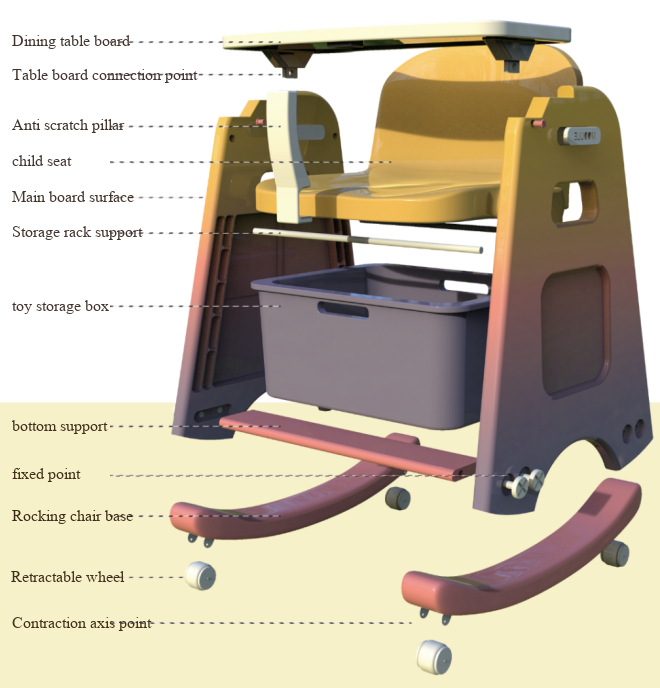
The Psychology of Design Analysis and Redesign of a ‘Growth-Accommodating’ Children's Dining Chair
Keywords:
Design psychology, Three level theory, The stages of children's development, User research, Children's table seats, Growth designAbstract
Abstract—This paper presents an innovative conceptual design of children's table seats oriented to growth design, and constructs a dynamic product system suitable for children's whole growth stage from the perspective of design psychology and children's development law. Inspired by the multi-dimensional interaction needs of children's instinct layer, behavior layer and reflection layer, the design integrates psychological adjustability mechanism and modular architecture, and realizes seamless adaptation between products and children's growth process through flexible adaptation components and elastic interaction structure. These multifunctional design modules are conceived to combine contextualized morphological adaptation capabilities, adjustable functional components for precise matching of children's physiological development, and interactive emotional resonance design to strengthen children's emotional attachment. A child-centered experiential design is proposed to manage the functional form and emotional value output of the product, allowing adaptive adjustment based on the psychophysiological characteristics and use scenarios of children at different stages of growth. This method aims to solve the limitations of stage fracture, insufficient growth matching degree and lack of emotional care that are common in current child table seats by providing enhanced growth adaptability, extended product effective life cycle and deep emotional experience value, paving the way for a new generation of adaptive and emotional child growth products, and helping children develop good behavior habits.